
Maundy Thursday

We had a joke about today when I was a kid; you probably did, too: how can it be both Monday and Thursday at the same time? Yeah, it wasn’t really funny, then, either, unless you were a third grade boy. At least some third grade boys in those days knew that this particular Thursday was different from all others, something I tend to doubt about today’s children (but that’s my negative comment for today – sorry!).

Maundy Thursday: “maundy” from the latin “mandatum,” meaning “mandate” or “command.” This is the day, or evening, that Jesus established the most-important sacrament, Holy Communion, the Last Supper, the Eucharist.

I grew up in a church that practiced weekly communion. Actually, since we had communion at Sunday evening service as well as Sunday morning, it was practiced twice a week, now that I think about it. The question of whether you should take communion on Sunday evening if you had it in the morning never came up.

It did a few years ago when a church I attended attempted to have a contemporary service on Sunday evening and offer communion as part of the worship. One of our elderly planners argued that you should not take communion if you had had it in the morning. Ever the one to argue with her if a chance was offered, I simply said, “What difference does it make? If someone wants to receive communion a million times a week, what is that to us?” She just didn’t beleive it was “right,” she said, as though participating in Holy Communion was an obligation rather than an opportunity. And yes, I was evil and kept the argument going for another 15 minutes, just to be mean.

I was a young teenager in what was then called “Junior High” when I first heard of someone skipping church because of communion. I was in the school office for some reason (not disciplinary!) and overheard two of the administrative assistants talking about whether or not they would be in church the following Sunday. One of them said, “No, it’s a communion day, so we’re going to the mountains for a picnic.” It’s no wonder I don’t recall why I was there: this was scandalous to me! Miss communion?

In my home church, Holy Communion was done in the middle of the service, before the sermon. It was rare that anyone in my household missed church for any reason, but a couple of times a year we would go to worship and leave in the middle – after communion! I learned that the sermon was something done by people, but communion was something offered by God, and therefore you didn’t miss it. Sort of like kids going to school for a partial day: you have to stay a certain amount of time to have it count as a whole school day. Our church attendance counted because we had received communion from God.

What does communion mean to you? Is it something that distracts from the “real” service? Are you at worship only to hear the sermon, or to also receive communion? One of my mystical seminary friends once remarked, “It’s all communion!” and that’s an opinion that I have claimed as mine ever since.

Holy Communion is not, in and of itself, the only way that Jesus the Christ is present to us. No, it’s a signpost: yes, he’s here in this gluten-free breadlike substance and in this tawny port wine, but these are just a reminder that he’s with us in Coke and pizza, or beer and pretzels, or donuts and coffee. It’s a reminder that God is present with us. “As often as you do this…” is significant, and African-American preacher once told me, “with an emphasis on ‘often!'”

One of my college professors scandalized some of his students once by saying, during a class that was studying worship, that if we really believed that the words of institution (“this is my body…this is my blood”) really turned the bread and wine into the body and blood of Jesus, then we ought to be on the street corners handing it out to the world instead of taking up the “leftovers” and storing it in some holy box in a sanctuary somewhere. A couple of students almost fainted.

Holy Communion really has no boundaries. I’ve seen it done with creek water at camp. Fried chicken and sweet iced tea would be the Sacrament if Jesus had been from the American South. I have no favorite communion substance: grapes and cheez-its, s’mores around a campfire the last night of camp, matzo crackers and grape juice (what I grew up with – I still cannot taste Welch’s grape juice without thinking of Jesus!), whole wheat bread and tawny port wine (the communion at Duke Divinity School each Thursday when I was a student). All of these remind me.

Of what?

We had a camp communion service many years ago, and the young campers were the priests at the Table. One little ten or eleven year old came up to me and said, “Jamie, I don’t know what to say.” So I asked him what he remembered from church, then we wrote down the words. We got to worship that night, and while he had  remembered to bring his flashlight, his notes were left on his bed. None of us knew this: he was too embarassed to admit that he had forgotten his notes after all the time we spent writing them up for him.

He got to the Table, stood there, a chalice with grape juice and the paten with whole wheat pita bread before him, and it was then that he announced that he had forgotten his notes. He stood there for a minute, total silence filling the air – even the crickets were still for a moment, it seemed. We adults held our breath, trying to decide at what point we could rush forward to help him.

Suddenly, he took the cup and the paten, held them up, and said in a clear, loud voice:

“This is Jesus… for YOU!”
Posted in Uncategorized | Leave a comment

Wednesday

We’re almost there.

Almost there, as Jesus prepares himself for the ultimate showdown with power, both the religious power of the Jews and the political power of the Romans.

Almost there, as Jesus prepares himself for the continued cloud of unknowing in which his followers live, making up their own versions of who he is and what he is about.

Almost there, as Jesus prays, “Not my will but yours….”

Almost there, as the betrayal occurs that gives the world a name for betrayal, “Judas.”

Wednesday is mid-week for us, and there’s a kind of waiting that goes with it. Waiting, the story of people of faith: waiting to see if all of the things we hope are true, waiting to see if any of this ultimately matters.

But this Wednesday is different for Jesus: it’s the last day he’ll be just a normal person.  Thursday, he says his good-byes; Friday, he dies; Saturday, he’s dead and buried; Sunday, he’s the Risen One.

Wednesday is like the day before you go to the doctor with something serious. You know that most likely, the news will be bad. You search for hope in your heart. You try to surrender and trust. You know that it will be what it will be. It’s the last day that you won’t know what is going to happen.

Jesus waited. He taught, but in his heart, he waited. He thought. He worried. He prayed.

He sounds like the rest of us.

God, living a human life.

Posted in Uncategorized | Leave a comment

Tuesday Love

When the Pharisees heard that he had silenced the Sadducees, they gathered together, and one of them, a lawyer, asked him a question to test him. “Teacher, which commandment in the law is the greatest?”  He said to him, “‘You shall love the Lord your God with all your heart, and with all your soul, and with all your mind.’  This is the greatest and first commandment.  And a second is like it: ‘You shall love your neighbor as yourself.’  On these two commandments hang all the law and the prophets.” (Matthew 22: 34 – 40)

It’s important not to forget that this whole story is about God’s love for us. We may walk through the week with Jesus, remembering all of the things he said and did during the week. We are already anticipating Judas’ betrayal, the Last Supper, the Arrest, the Trial(s), the Scourging, the Crown of Thorns, and ultimately, the Crucifixion.

We also look at the Gospels and see their different stories. Some may say that these stories are contradictory, and that’s fine: we each see the things we see. I know plenty of Christians who pretty much ignore this whole thing, so I have no problems with non-believers being critical of us. Yes, the Gospel writers, although having some similarities (Jesus does, after all, end up dead in all of them), tell different stories. History doesn’t mean the same to them as it does to us. We look for facts and fail to see truth. They are poets, mystics, visionairies; we are stoics and scientists.

Somewhere in all of this is the love of God. This whole story is a stumbling-block, not just the cross on Friday: St. Paul had that much right.  All of our theories of the Atonement, our understandings that end up making God look like a child-abuser, and our rebuttals of that, seem to leave out the idea that God is love. This story doesn’t have a lot of love in it: that’s because of us, not God.

I the midst of the week of preaching and teaching and making decisions that would ultimately end his life, someone asks Jesus, “What is the greatest commandment?” We know how that feels. We have all been in the midst of some terrible crisis, so distracted by our own worries and fears that we can hardly breathe, when suddenly, someone requests of us a meaningful statement, an act that takes us out of ourselves and into ultimate reality.

What is the greatest commandment? Jesus must have paused for a moment, remembering what he was about: to be the way God wants to be known in the world. What is the greatest commandment?

Keep all the commandments without veering one way or the other? No.

Keep Kosher? No.

Believe every word of the Bible? No.

Go to church every Sunday? No.

Tithe and pay your pastor well? No (Rats! That would have been a good one! But not a GREAT one).

No.

Love.

Love God.

Love your neighbor.

Everything else is dependent on these two.

All the commandments, all the parables, all the Psalms, all the history, all the prophets: everything hangs on love. Without love, everything else is bull. Everythings else is meaningless.

Love is the common denominator that links all of this together. We cannot understand God if we do not, at some point, consider the love of God for us and the loving of God by us.

If nothing else is said for the rest of the week, this lesson has to be understood, has to be taken into our hearts, has to be lived out.

Maybe what we need this week, rather than a theologian, rather than a preacher, is just the heart of a child.


Posted in Uncategorized | Leave a comment

Monday of Holy Week

Day 2: things are beginning to intensify for Jesus, his followers, the Jewish leaders, and the Romans.

Romans? Surely they don’t come into the picture until late Thursday night, right?

Come on folks, let’s not be unrealistic. If you are one of those people who believes that thousands followed Jesus around and came to hear his sermons, then you have to realize that the Romans noticed just like the passersby. If you know your history, you know that no Roman wanted to be stationed in Judea: it was one of the most dangerous backwaters in the Empire. Add to that the fact that if thousands gathered around in any situation in those days, it would drain the towns and cities (and there weren’t really any huge cities around like we think of them today) of people, pissing off the merchants, hurting the economy, and causing the shopowners and salespeople to go complaining to the authorities. The authorities then took action.

I’m not certain there were thousands, but there were enough. Was I the only kid in Sunday School who couldn’t understand why the Jews have been persecuted throughout history? The word ‘Christ-killer” wasn’t in our vocabulary in those days, and I know for a fact that my super-smart preacher’s kid friend wasn’t the only other person who figured out that the Jews weren’t as responsible for the death of Jesus as the Romans were! Any study of  New Testament times will reveal that crucifixion was a Roman form of punishment, not a Jewish one. The Romans didn’t particularly care who they used it on, but it was especially grizzly and painful for political rebels. They did not react well to being rebelled against!

So, Monday in Holy Week is also the beginning of not one plot, but many, to do Jesus to death. Whether Jesus talked about himself in earthly terms or not, his followers heard the only way they knew how to: in earthly, political, here-comes-the-kind terms. They were excited. They anticipated. David’s kingdom was coming back. Political and religious understandings of the Messiah had merged into this person, Jesus. The Jewish leders were sweating; but the Romans watched and readied themselves.

The time had come: bye-bye, Romans!

Posted in Uncategorized | Leave a comment

Palm Sunday

For the pastor leading worship today, a paradox: the joy and triumph of Jesus’ entering Jerusalem AND the beginning of the worst week of Jesus’ life.

Yeah, I know, there’s Easter in sight: for us. For Jesus and the disciples and hangers-on and friends and family, there’s just these moments. The last week. Whatever happened on Palm Sunday rapidly fades into a week of intrigue. It makes a great movie. Maybe even a miniseries:  You can just hear the TV announcer saying, “Tonight, on The Last Seven Days of Jesus, see the Sanhedrin meet in secret and bring Judas into the plot to kill the Savior.” You could run it all week. If you use the St. Matthew account, the Good Friday episode would make for some great TV special effects.

The truth may be less thrilling than the TV show. Jesus had a following, that’s for sure: you don’t get yourself killed by the Romans (NOT the Jews, although the Jewish leaders certainly didn’t mind arranging things so that they did not have to break the letter of their law) for having twelve or so following you around in the woods. You have to wonder, though, what didn’t make it into the Gospels: are there things that Jesus said to make the Romans think he was planning a real coup? What don’t we know? What can we see by reading between the lines of the Gospel? If we were Jewish rabbis, what would be our Midrash, our story-behind-the-story, to explain why the Romans didn’t mind killing him (no matter how good Pilate has been dressed up so he doesn’t have to take the blame)?

We Christians are oh-so-careful not to add or subtract from the story, but our Jewish ancestors didn’t shy away from that approach to understanding scripture – and life! Midrash is telling “the rest of the story,” and it doesn’t have to be factual, it just has to explain “maybe” why something happened.

Maybe the Romans perked up some when this itinerant preacher comes riding up on a donkey with a noisy crowd, made up of passersby who were whipped into a frenzy by Jesus’ followers yelling “Hosanna,” joined in the screaming. Maybe the Gospel writers, writing at a time when perecution of the new sect was gaining intensity, thought it better to blame the Jews for Jesus’ death rather than the Romans, thus taking a little heat off themselves.  Yeah, that’s it: when you tell the story, find a scapegoat; don’t blame the real perpetrators of the Crucifixion (a Roman, not a Jewish, form of torture to death)!

Palm Sunday has a kind of strange celebration that changes midstream: in many churches, a processional meant to reenact the “Triumphal Entry” of Jesus into Jerusalem, with some kind of palm blade or branch, is held at the beginning of the service, but in the liturgical season of Lent, while we can shyly and half-heartedly shout, “Hosanna! Blessed is he who comes in the name of the Lord!” we cannot say the real praise word, “Alleluia!” That’s just the liturgical law, sorry. At some point, halfway through the service, it’s time to get back to reality. The parade was nice, thank you all for coming, but this guy Jesus might not be all he’s cracked up to be. And so the trouble starts.

The work of the pastor includes ministering to those folks who show up on Sunday but won’t be back during the week for Maundy Thursday, Good Friday, and whatever vigil might be held on Saturday. She’s got to move everyone through the week and end up with a dead guy. We go from joy to mourning. It’s not easy; the liturgical gymnastics it takes to do this means being really flexible spiritually; AND you’ve got to not spoil everything for the people who WILL take the time to be involved in the special Holy Week observances.

Damn! The preacher really DOES have to work hard sometimes, right?

Palm Sunday: appreciate what’s happening, if you choose to be in church that day. And let your pastor rest after it’s all over: this is deserved!

Posted in Uncategorized | Leave a comment

Why Spirituality Matters

On the day of the Marjorie Stoneman Douglas High School shootings in Florida, the immediate reaction of politicians (and others) was something to the effect of, “We send them our thoughts and prayers.” And the responses to this, even among religious communities, was a loud rejection of that as the only response. I agree with those who condemned the pious, meaningless response.

However, in the wake of all this violence in our society, is there a place for a spiritual response? Are prayers simply empty entreaties to a non-existent entity? Does spirituality matter in this insane world?

I have written before about how the Civil Rights movement leaders expected both spirituality AND action from those involved in demonstrations and other civil disobedience. The two are interconnected. Without spirituality, all we have is good works that are tied to nothing but the immediate action. When nothing changes immediately, we can easily think, “We failed,” and give up. Without action, spirituality can be nothing but staring at our eyelids, hiding from the world.

Meaningful action is undergirded by a worldview that goes beyond the immediate moment. Spirituality connects meaningful action to the whole of what is happening in the universe. My little action here might appear to have failed, but having a deep spiritual undergirding to my action means that I may not actually see what is happening as a result of my action. I am able to be patient. Seeds take time to germinate, to grow a plant, to create a flower or food.

In  the short run, things may not change. But knowing that deep change is a slow-moving stream (which I learn only by sitting still, being quiet, and connecting to the whole, to God) gives me patience and strength and even excitement to see what will result from my attempts. It also connects me to others who are likewise engaged. We are not alone.

We pray, then we do, then we pray, then we do some more. I mean, just look at Jesus: he failed so miserably, if we measure his short life by what happened while he was alive. We, his followers, are not perfect, but there’s a lot of good that has happened in the world to this day (and I don’t ignore the bad that Christianity has committed in his name) that might not have happened if not for him: some of the hungry are fed, some are clothed, some are housed, some of the sick are visited, some prisoners are set free. The fact that we have not been completely successful does not deter us from continuing to work to save the environment in spite of setbacks, to preach peace in spite of the love of violence of this world, to try to love the world that God loves in the ways that God loves it.

Yeah, I do think spirituality not only matters, but is vital to the life of anyone who wants to make a difference in good ways in the world. What kind of spirituality? One that insists not on its own way, but on a way of love, the way of God.

Posted in Uncategorized | Leave a comment

A Little Environmental Reality for Me

There is an old evangelical term that I don’t hear in my religious circles much any more: “convicted.” It’s a legal term to most people, and in Christianity, when you are “convicted,” it means pretty much the same thing as in legalspeak: to be found guilty. In Christian terms, it means we are struck hard with our guilt for something or other.

I spent part of this weekend at a conference here at Christmount which was led by an eco-theologian, Dr. Leah D. Schade, Assistant of Preaching and Worship at Lexington Theological Seminary (check out her blog at http://www.patheos.com/blogs/ecopreacher/).  She did a couple of things that really struck me, and I want to share them with you. Maybe they’ll do something similar for you.

First, I want to say that I truly care for our planet. I’m not perfect about my care, but then I’m not known for being perfect at much of anything. I AM aware of how even little things like turning off the water while I brush my teeth can make an impact on the world. We’ve recycled for years, we quit buying styrofoam stuff ages ago, I finally bought a Prius, and we try to turn off most of our lights when we are not using an area of the house. We’re trying to do more.

But I’m not much in the way of an “evangelical” environmentalist: I don’t usually preach to people (except my camp staff!) about things they are not doing, I don’t drive my friends crazy by being a one-note song, and I don’t complain about those who disagree with me, either because I’m NOT that way or because they don’t do the first thing to help save the planet.

No matter how good you think you are at something, though, there is always more to learn. One of the reasons I love the saying, “Better to be silent and thought a fool than to open your mouth and remove all doubt” is that as a youngster, I was good at the latter: opening my mouth and revealing my ignorance. So good at it was I that I perfected it in college (you may leave your examples in the “comments” section, “friends!”). I like to think of these latter days as my gently testing the waters of “my opinion,” realizing as I do that, like bodies, all of us have, and trying to remember to respect those with different ones than mine.

This weekend, I learned a couple of new ways to think about ecology. I’m grateful not only to Dr. Schade, but to the participants of Christmount’s annual “Elders and Deacons Workshop” who shared some of their insights and passion for this beautiful world of which we are a part. The first thing that struck me as valueable was having the group talk to each other about their environmental biography, in which they talked about their parents’, grandparents’, and even great-grandparents’ relationship to the land, how that changed over the years, and then their own understanding of that relationship. She ended the evening with a sermon/liturgical dance of Mother Earth praying excitedly to God at he beginning of creaton that she couldn’t wait for what was “next” in creation. The sadness as the sermon progressed and the humans began not loving but hurting her and losing their connection to her. There were authenticly teary moments among our little group.

This morning, we were challenged to go out into nature and see what spoke to us, drew us closer, and then to bring it to the group and share as though we were that thing: one person was water, another was a tall tree, and we even had lichen speak to us! Some people noticed the change in weather patterns that was causing confusion to many plants and animals.

I thought about my beloved crows, who are so smart that they recognize different human faces; they seem to be outside in the parking lot all the time during the spring, summer, and fall, and I know that they know me. I cannot tell one of them from another, but I often speak to them quietly as they scream at me when I walk past (although I have noticed that they don’t fly away as quickly as they used to, making me think that they may have told the others , “he’s a little strange but basically okay, “which is kind of how I move through the world anyway, so it’s all good!

It was beautiful to listen to participants talk about the interconnectedness of everthing. We were reminded that St. Francis used to preach to the animals and plants around him. And sad to realize how Christianity has married itself to capitalism to the point that places like my little town allows every stand of forest and pasture to be bought up and built on “in the name of progress,” as though progress will survive without air, water, and plants, and the real sorrow of this is that too many of the supporters of this kind of development consider themselves – and are considered by many of their pastors and fellow church members – to be “good, Christian people.” Hmmm.

But I cannot worry too much about them. I need to make sure that I’m doing better. Does the light in my office have to be on all day? What needs to be unplugged? What will I do with my trash? Can anything be reused.

Oh, my, I am going to be a problem child again!

Posted in Uncategorized | Leave a comment

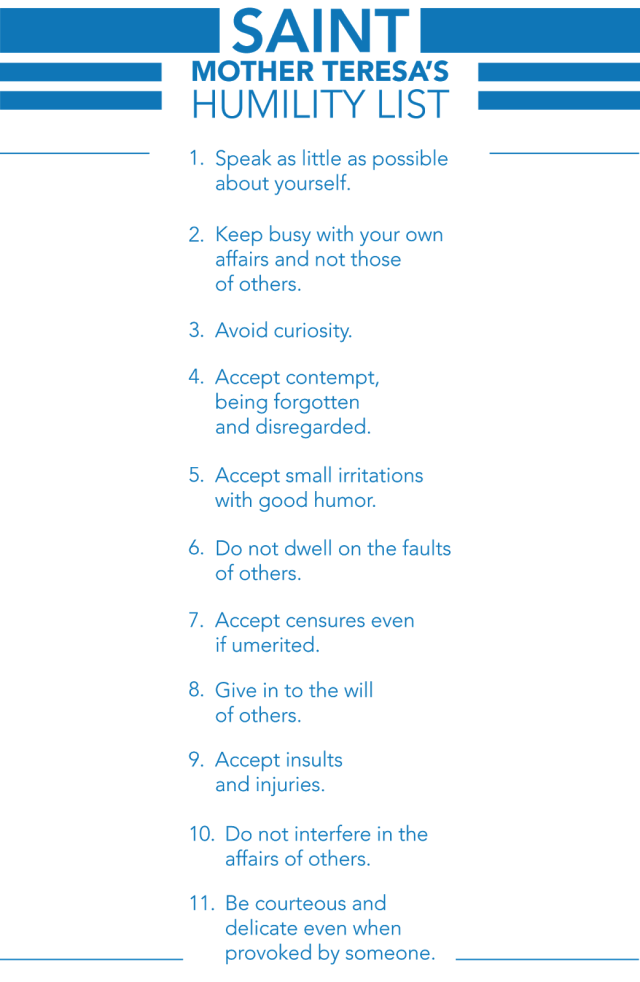
Humility List

I ran into this little list on Pinterest this afternoon and thought it might do for something to think about.

Humility is a difficult concept for our culture. We spend a lot of time trying to build self-esteem in those who have been abused in all the many ways our insane society does this to people, especially but not only to children.

Another problem for us, though, is pride and arrogance. So, for all of us, humble or arrogant, Saint Mother Teresa’s little list is something on which to meditate. And to be honest, she is so much smarter than I am that this will be worth reading!

I will warn you, though: some of these sound like she is suggesting you be a doormat! Think on this: not all of these may be healthy for you, but humility is certainly something this world use. I think it all depends on where you are in your personal growth. Take what you can and leave the rest to the saints!

My favorites: #1, #2, #4, #5, #6 (over and over and over again), #10, and #11. I guess I especially love #1: I don’t like to listen to others tell me how holy they are, how good a Christian they are, and how much they do for the world; and I promise I won’t tell you how holy I am (since too many of you know the truth!).

Posted in Uncategorized | Leave a comment

The Jesus Prayer

I love to pray the Prayer of the Heart, also called the Jesus Prayer: Jesus Christ, Son of God, have mercy on me. The ancient prayer was, “Lord Jesus Christ, Son of God, have mercy on me, a sinner.” One of my friends likes to pray, “Jesus Christ, Son of God, have mercy on me, one whom you love.” I like that. To keep it from being all about me, I often pray, “have mercy on us,” or I name a particular person, “have mercy on _________.” The Orthodox church originated this prayer, based on the many times in the Bible someone says, “God, have mercy on me!” Especially, it has at its root the parable of the Pharisee and the tax collector in Luke 18, where the most honest prayer was recognized by Jesus to be that of the tax collector who cried out, “God, have mercy on me, a sinner!” I understand the Orthodox practice is to say the prayer interiorly so often that it begins to pray itself within you.

If you want to learn more about this practice, you can find it in the book, The Way of the Pilgrim. It also shows up in J.D. Salinger’s novel, Franny and Zooey.

I once went on a Jesus Prayer retreat. What we did was, basically, sit in silence and focus on praying the Jesus Prayer over and over. When we inhaled, we prayed, “Jesus Christ, Son of God,” and upon exhaling, “have mercy on me, a sinner.” Over and over, probably hundreds of times if not, eventually, thousands. Sure enough, in the middle of the night the second night, I woke up with the prayer saying itself within me. I thought this was one of the nicest things that had ever happened in my spiritual life.

The importance to me of this kind of prayer is great. First, it gets my ego out of the way: I am actually “lost” in an awareness of the Christ present with me. Next, it keeps me from “asking” for lots of things to transpire, as though God doesn’t have a clue as to what is happening in the world. Finally, for me at least, I don’t run out of things to say before God (how often have people been told to “pray without ceasing,” only to realize that if we pray to God with a catalogue of needs, we will eventually be prayed out?).

Over the years I have used the prayer silently in all kinds of crises: at the bedside of a parishoner in ICU; while married couples argued loudly in my office; when campers worshipped God to the best of their ability; all day on September 11, 2001; with friends and family in times of crisis; when I’ve learned of the death of friends and family; and finally, every day, as I remember those on my prayer list.

I’m no saint. I’m not even holy in any way unique from the way you are holy. What I am is a person in need of an awareness of the presence of God pretty regularly. Maybe you are, too. Be my guest. Pray the Jesus Prayer. You’ll go beyond being my guest: you’ll be a guest in the house of God

Posted in Uncategorized | Leave a comment

Fear

Michael Yaconelli, in Dangerous Wonder, suggests that American Christians have lost their fear of God. While years ago I tried to talk about God as our friend, as our lover, as the One who loves us no matter what, I see what Yaconelli is getting out: familiarity and lack of fear of God is not always a good thing.

This is dangerous ground: I want to be as clear as possible. It is so easy to get comfortable with my relationship with God that I cannot fathom a God different from the one I have shaped. I think this is probably true of lots of American Christians. Watching the occasional religious broadcast on TV, I either hear harsh judgments of secular society (inevitably made up of “liberal,” whatever they are) or what I call the “buddy-nature” of God, where God bargains with us to make us rich. Either way is wrong. Big time.

Christianity is based on the teachings and life of one Jewish teacher named Jesus. What Jesus taught and how he lived had nothing to do with huge buildings, getting rich, owning lots of stuff, cheating people out of that same stuff, power for powerful people, nationality (not even traditional Jewish nationality of his time), or anything else on which modern American Christianity has gotten in its sight.

One of the things that has always terrified my about my faith is that if I live like Jesus, I’ve got a lot of things to give up. Luckily, I don’t collect jewelry; no, my material desires to toward musical instruments. I don’t have desire for a motorboat; my car doesn’t have to be the newest or coolest or fastest. The most expensive clothing bothers me not at all. Owning a house in the right neighborhood is a boring thought that moves me very little.

I did spend a boatload of money on my education, though, and I’m occasionally quite proud of it. It was important to me on my last car purchase to buy a hybrid, and while I may shyly say, “I wanted to go greener,” the truth is that I think, “HAH! I got a green car (in more ways than just its environmental impact).” I’m quiet about the make of my guitars, but I love it when a real musician tells me, “That thing has a sweet sound.”

And then I read the Gospels. Hey, so do you.

When Jesus talks about selling all that I have and giving to the poor and following him, I get a little scared. What does he mean? How do you hear this if you believe in the prosperity gospel? I try not to be greedy – that’s one of my other pet peeves, greed – but how does God see my tendency to hold on to what I have?

When Jesus talks about the end of time, the time of reckoning, and says that I didn’t feed him or clothe him or visit him, I’m shaken to my core. I think I try to do some good things, but then, so did all the other “goats.” It worries me. About me. About you.

When Jesus suggests that even loving my family and friends above following him, I suggest to him that he has gone from preaching to meddling.

There is a lot that is scary in this Gospel, this so-called good news, of Jesus of Nazareth. I’m not sure I can just shrug it off. Sitting comfortably in a pew and thinking the “great thoughts” sure seems like a good religion to me, but when I am challenged to get up, to go out and love the ones God loves, I find it a bit terrifying.

I know about forgiveness, but is there forgiveness for hatefulness? Is there forgiveness for prejudice? Is there forgiveness for greed? Is there forgiveness for the whole list of things we do that are against life, against people, against the marginalized?

Yeah, I think we need to have some fear.

Posted in Uncategorized | Leave a comment